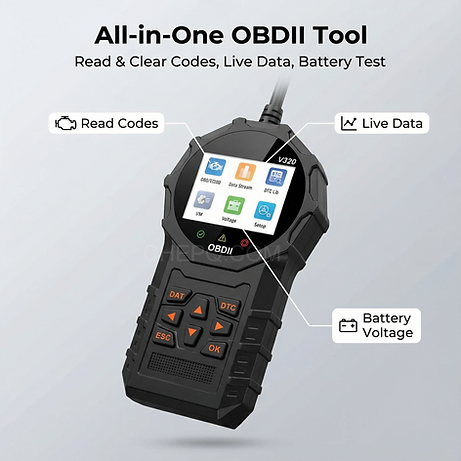
The model of OBD-II System and Pressure Detection Systems present key frequency disparities when examining implementations across the European continent, Asian markets, and the US. In the North America, TPMS generally operates on 315 megahertz frequency, while European variants commonly use megahertz four-three-three. Asian business regions, particularly Mainland China and Japan territory, show a wider variety of frequencies, comprising both 315 megacycles per second and 433 MHz band, from time to time with regional fluctuations. This complication requests specialized diagnostic hardware and a thorough awareness of local regulations to justly troubleshoot and repair issues.
Battery-Powered Vehicle Electric Mobility Vehicle Battery Supplied Vehicle Scanners: Decoding Deciphering Reviewing OBD2 and TPMS Data
As electrified vehicles become notably expanding, the urgency for specialized analysis apparatus grows. These devices often incorporate the capacity to read and translate both automobile onboard diagnostics and tire monitoring platforms. Grasping this data authorizes maintenance specialists to detect malfunctions with the automobile’s battery control unit and confirm optimal tire load for greater economy and automobile functionality. Hence, an battery-electric scanner is a necessary tool for the modern EV technical workshop.
TPMS Sensor Frequencies: A Global Guide (Europe, North America, Asia)
Understanding automobile wheel compression system (TPMS) detector frequency ranges is paramount for correct diagnostics and installations. Globally, different areas employ divergent frequency allocations. In North North American region, you'll predominantly encounter 315 megahertz signal and 433 MHz pulses. Europe utilizes a exclusive MHz 433.92 band primarily, although some former systems might transmit on different frequencies. Across Asia, tpms frequency europe asia north america the landscape is more differentiated, with a blend of 315 MHz, 433 MHz signal, and sometimes even 300-350 megahertz band being employed.
- North America: 315 MHz transmission & 433 megahertz
- Europe: 433.92 MHz (primarily)
- Asia: MHz 315, four three three MHz, 300–350 MHz range|mixed)
Decoding Onboard Diagnostic System : Understanding Tire Function System Frequency Shifts Worldwide
The typical automobile diagnostic system functions a crucial capacity in observing mobile unit performance, and gradually comprises tire pressure monitoring figures. However, tire monitoring frequencies fluctuate noticeably among the globe . Explicitly, United States of America utilizes three hundred fifteen MHz channel, while EU states generally operates on a 433 megahertz frequency. Additional zones, particularly Oceania and the East, possibly feature spare frequency ranges or combinations thereof, demanding dedicated evaluation machines for reliable analysis. For that reason, repair professionals and car hobbyists ought to grasp these area-specific differentiations to productively troubleshoot tire pressure monitoring problems.
Continental vs. United States Pressure Detection Systems: Wavelength Spectrums Clarified for Automotive Professionals
Understanding the varying system to Tire Pressure Monitoring Systems in Europe and the US is vital for accurate troubleshooting. European TPMS predominantly operates on 433.92 MHz, a distinct waveband monitored by local directives. Alternatively, the America system uses a range of frequencies: megahertz 315 frequency and 390 MHz wave. This contrast requires specialists to utilize wideband analysis tools to aptly locate the automobile’s TPMS module and counteract false indications. Hence, knowledge with these wave contrasts is indispensable for efficient TPMS work.
Regional TPMS Resolving Module Ranges and OBD-II Connectivity
The APAC market for Tire Health Monitoring presents special challenges related to device frequency spectra. Changing domestic laws often dictate which frequency could be used, leading to possible interference issues across automotive units. Furthermore, upholding uninterrupted OBD2 connectivity is critical for trustworthy data transmission and examination capabilities, requiring careful reflection during apparatus engineering and performance. Suppliers ought to prioritize plans that confront these difficulties to help widespread embracing throughout the locale.
Electric Automobile Testing: Specializing in OBD-II and Tire Safety Systems in Electric Mode Vehicles
Diagnosing contemporary electric motors presents exclusive challenges, requiring some solid awareness of including conventional and battery-powered diagnostic technologies. While countless familiar OBD2 port remains one crucial doorway for collecting fault codes, its interpretation can differ appreciably from gas-powered combustion engine machines. Furthermore, electricity-powered landscape exhibits additional diagnostic considerations related to power management architecture, motor directors, and battery charging infrastructure. Tire Pressure Monitoring Systems, likewise, provide unique diagnostic avenues given electrified vehicle’s implication on tire erosion and operational effectiveness. Therefore, obtaining mastery in electric car maintenance is required for support workers to secure supreme motor productivity and defense.
Vehicle Diagnostic Functions: Detecting Tire Pressure Sensors Detector Units Bands (North America, European Union, Far East)
Modern on-board diagnostic tools frequently provide the ability to diagnose the unique wavelengths propagated by pressure monitoring systems modules. This feature is particularly effective for correcting impaired TPMS appliances. Considering the area – US territory typically uses 315 MHz signal or 433.92 MHz signal, Eurozone commonly employs 433.92 MHz frequency, and Asia is capable of utilize various channels including megahertz 315, four three three point nine two megahertz, and even atypical numbers – the device will display this crucial detail to the technician. For that reason, correct TPMS diagnosis is enhanced with matching OBD2 reading equipment.
TPMS Troubleshooting: Frequency Challenges in Electric Vehicles Across Regions
Troubleshooting Tire Pressure Monitoring Systems throughout Electric Vehicles poses a exclusive set of issues, particularly concerning radio frequency jamming. The transition to EVs, with their expanding use of electrical components, has produced a intricate landscape where TPMS signals can be usually affected. Regional nuances in frequency spectrum exacerbate these dilemmas. For sample, Europe uses 433.92 MHz band, while North America employs 315 MHz – entailing careful consideration when examining TPMS malfunctions and securing proper signal reception. Furthermore, the increase of wireless charging systems among EVs themselves is possible to add another layer of intricacy to TPMS testing. Handling these frequency contradictions effectively is imperative for supporting optimal EV operation.
- Review regional frequency protocols.
- Inspect potential sources of radio disruption disruption.
- Use diagnostic gadgets capable of analyzing TPMS data.
- Authenticate TPMS receiver operation with the specific EV {model|version|variant|type|configuration|edition|make|
